
22/02/2022
India's foremost Jurist, a jazz aficionado & champion of human rights: Mr Soli J. Sorabjee
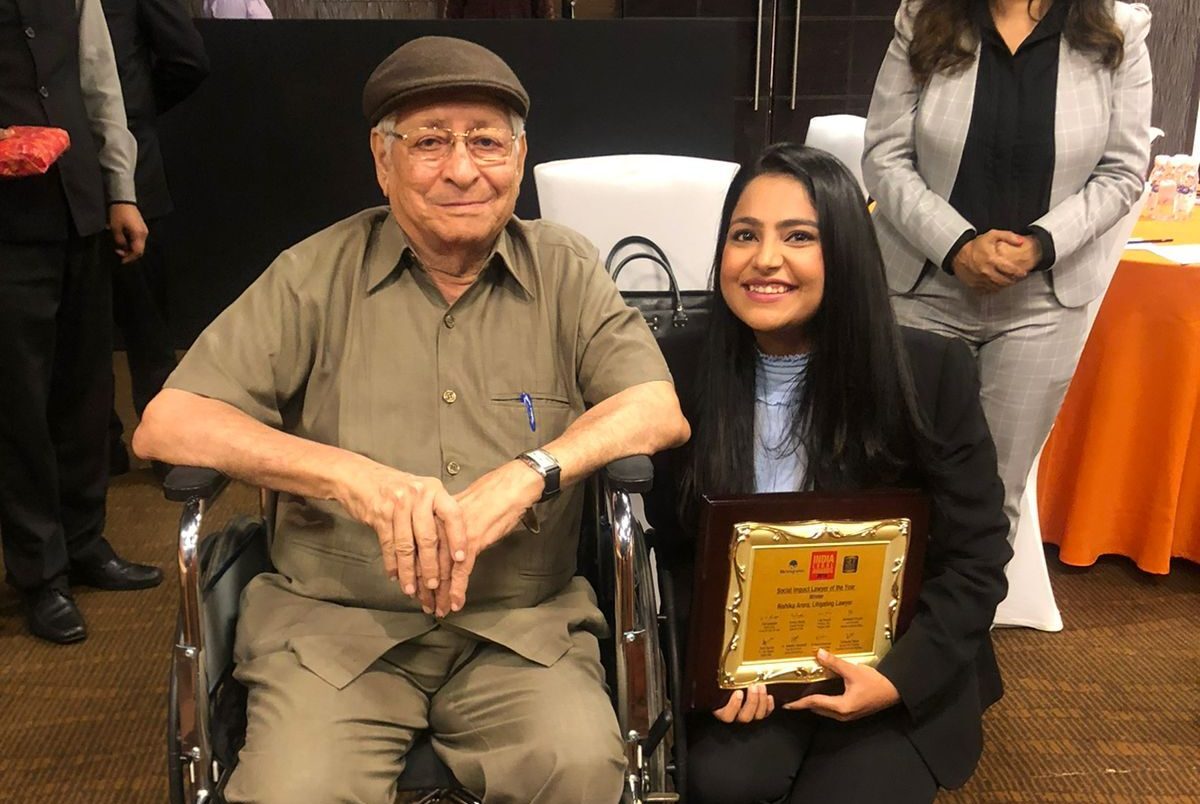
Authors : YCLA Committee members Rishika Arora, Siddharth Sijoria and Rahul Kumar
Born to an affluent Parsi family in 1930, Mr. Soli Jehangir Sorabjee carved his name among the greatest judicial minds in the world. He gained his legal training from Bombay Law College alongside luminaries such as Fali S Nariman and Ashok Desai. Early on in life, Mr. Sorabjee had little enthusiasm for a commercial path, but decided to pursue a career in litigation. With eloquence as his core strength, Mr. Sorabjee established himself as an advocate par excellence and rose to hold some of the top legal offices in India that every lawyer aspires to. However, his career is not renowned merely for serving the prestigious office of Attorney General. Instead, it is his able representation of landmark cases concerning human rights, separation of powers, civil liberties, federalism, and other constitutional principles which has shaped the role of law in improving governance and combating regressive social practices which hinder human development.
Mr Sorabjee began his legal career in Mumbai in 1953 as a young associate in the chambers of renowned Senior Advocate (Equivalent to Queen’s Counsel) Jamshedji Kanga. He was exposed to wide range of constitutional, civil and commercial cases while working in Kanga’s chamber. His legal acumen was recognized by judges at his initial years at bar when he was appointed as amicus curiae by the Court overlooking his inexperience.[1] In his later interviews, Mr Sorabjee admitted that he did not have any “Godfather in the profession” and his struggle during early years at the Bar made him realise the importance of mentoring and encouraging young lawyers.[2]
In his long and eventful career, Mr. Sorabjee argued many landmark cases before the Indian Supreme Court that have shaped the course of Indian legal jurisprudence and the evolution of India’s democratic life. Amongst the list of important cases, one of the most crucial and earliest cases in which he participated, was the famous Kesavananda Bharati case[3] in which the Court developed the 'basic structure doctrine' that recognises implied limitation on the power of the amendment by the Parliament. Amongst the modern constitutionalist, the theory is now recognized as “Unconstitutional Constitutional Amendment doctrine” that limits the power of legislature to amend the basic or essential features of the Constitution.
The Indian Constitution under Article 30 guarantees the Minorities to establish and administer educational institutions. In St. Xavier’s case [4] the provisions of the Gujrat University Act, 1972 was challenged before the Supreme Court of India as it allowed the State to interfere in the functioning and administration of the Minority institutions. Mr. Sorabjee appeared for the Minority institution and was able to convince the Court to declare the law as unconstitutional as it violated the rights of the minority institution to run & administer its institution. The Court in its ruling observed that,
“The whole object of conferring the right on the minorities under Article 30 is to ensure that there will be equality between the majority and the minority. If the minorities do not have such special protection, they will be denied equality.”
During the infamous Emergency of 1975, India witnessed widescale Human Rights violations particularly the illegal detentions of Political Dissidents and curtailing of freedom of speech. During the Emergency, Mr. Sorabjee courageously represented the detainees. He argued in the ADM Jabalpur case[5] that Executive could not interfere with an individual’s liberty unless it could defend the legality of its action. [6] However, to his surprise, the Majority of the judges on the bench ruled against his arguments and justified suspension of fundamental rights during emergency. [7] Dismayed by the verdict of the court, he published an authoritative treatise on the government's attempts at censorship in The Emergency, Censorship and the Press in India, 1975-1977[8]. His writing holds significance because for the first time someone openly spoke of the publishers who sympathized with the then government's cause rather than standing up for the journalist fraternity and upholding the constitutional values.
Even later as Additional Solicitor General, Mr. Sorabjee represented the Government in another landmark case of Maneka Gandhi v Union of India[9], where the Apex Court clarified that the right of personal liberty granted by Article 21 of the Constitution is indeed sacrosanct.
Mr. Sorabjee gained international acclaim for his defence of human rights. He was even nominated by the UN Secretary General to be appointed as the Chief Prosecutor in Yugoslavia War Crimes Tribunal, but the proposal was denied by the Security council. In 1997, he was appointed the Special Rapporteur for Nigeria by the UN Chief Prosecutor Commission on Human Rights, where he submitted his recommendations on judicial independence and civil liberties. Mr. Sorabjee also served a member of Permanent Court of Arbitration at Hague from 2000-2006 and the Vice-President of Commonwealth Lawyers Association. He was also the member of the committee on Arms Control and Disarmament Law of International Law Association and was a lifetime trustee of the India International Centre.
Between 1989 and 1990, Mr. Sorabjee served as the Attorney General of India. Even though his tenure was short-lived, he often demonstrated his faith and loyalty in the constitution over the government of the time. Almost a decade later, he was reinstated as Attorney General under the first NDA coalition government in 1998. As a second time Attorney General, he spearheaded some of the major legal cases of the time including defending India against Pakistan at the International Court of Justice (ICJ). In response to the Indian Air force shooting down a Pakistani Navy plan flying over Rann of Kutch, the Pakistani Government filed a compensation claim before the ICJ for 60 million US dollars[10]. Representing India, Mr. Sorabjee argued that the court lacked jurisdiction over the issue and thus was able to secure India’s exoneration. Towards the end of his tenure as AG, he led another landmark judgment before Apex court, the T.M.A Pai Foundation[11] case, where a bench of 11 judges laid down the contours of governmental regulations on private institutions and still occupies the education field in so far as the constitutionality of statutes and regulations is concerned.[12] In recognition of his defence of freedom of expression and the protection of human rights, Mr. Sorabjee was decorated with the Padma Vibhushan in the year 2002.
Another constitutional value Mr. Sorabjee fought to safeguard was federalism. In the case of S.R Bommai c Union of India[13] involving the dismissal of an elected government by the imposition of president's rule under Article 356 of the Constitution, he persuaded a bench of nine judges to hold that the state government should be dismissed only when an impasse arises.[14] The drastic reduction in the use and abuse of Article 365 since the passage of the judgment reflects the impact his arguments have had in the evolution of the constitution.
During the Emergency and later during the Sikh pogrom of 1984, Mr Sorabjee gave his services for free, working tirelessly to ensure justice to the victims. Moreover, in the aftermath of the tragic Bhopal gas incident in the plant of Union Carbide Ltd., Mr. Sorabjee refused to represent the company in court and chose to represent the victims of the incident instead as a lead prosecutor against Union Carbide.[15]
Apart from building a glorious legal career spanning almost 70 years, Mr. Sorabjee was an avid reader of English literature and poetry. His love for poetry would often be reflected by the references and rhetoric used in his arguments. Another known passion of his was music. More specifically, jazz. His love for the art form was so profound that he became the first president of the Delhi Jazz Association and retained the position for several years. In fact, in the early years of his initiation to jazz as a college student, he floated his own jazz band, the SS (Soli Sorabjee) Quartet, where he would regularly play his clarinet. In the mid-70’s, along with other jazz fanatics in India like Niranjan Jhaveri, he jointly organized India’s first international jazz festival called “The Jazz Yatra” in 1978. His love for Jazz can also be deciphered from the fact that, when asked once that which he would prefer to be, India’s chief justice or Benny Goodman. He replied, “I would any day play like Benny Goodman, which I am doing in fantasy land now.” Mr. Sorabjee often urged young lawyers to ensure that they did not limit themselves to their profession and to cultivate interests in other areas such as literature, public affairs and human rights along with law.[16] He enjoyed interacting with the younger legal fraternity. Being a first-generation lawyer, he felt obligated to inspire his juniors. In fact, several doyens of the Indian legal industry, including Senior Advocate Harish Salve, former Solicitor General Advocate Gopal Subramaniam, as well as current Supreme Court judge, Justice UU Lalit, benefited from Mr. Sorabjee's able guidance.
Mr. Sorabjee often cautioned young lawyers against approaching the law from a monetarily lucrative lens. He believed that the law was a much more noble profession, for it allows an individual to work for as long as one desires. He often quoted "Lawyers don't retire, they practice till they die".
Siddharth Sijoria*, Rishika Arora** & Rahul Kumar***
* Practicing Advocate at the Supreme Court of India & Madhya Pradesh High Court
** Practicing Advocate at Delhi High Court
*** Student at Law College Dehradun Faculty of Uttaranchal University
[1] Kamala Nair Bombay v. Narayan Pillai Kumaran Nair 1957 SCC Online Bom 50
[2] Soli Jehangir Sorabjee- Sentinel of the Constitution, Vikram Raghvan 2021 7 SCC J-20 at
[3] Kesavananda Bharati v. State of Kerala, (1973) 4 SCC 225.
[4] Ahmedabad St. Xavier’s College Society v. State of Gujarat, (1974) 1 SCC 717
[5] DM, Jabalpur v. Shivakant Shukla, (1976) 2 SCC 521.
[6] Supra at 2
[7] Justice H.R Khanna was the Dissenting judge who held that Laws are not silent in the times of war. The case was later overruled.
[8] Soli J. Sorabjee, The Emergency, Censorship and the Press in India, 1975-1977, Writers and Scholars Educational Trust (1977).
[9] Maneka Gandhi v Union of India (1978) 1 SCC 248.
[10] Aerial Incident of 10-8-1999 (Pakistan v. India), 2000 ICJ Reports 12.
[11] T.M.A Pai Foundation v. State of Karnataka (2002) 8 SCC 481.
[12] Available at: https://www.legalbites.in/case-analysis-tma-pai-foundation-v-karnataka/.
[13] S.R. Bommai v. Union of India (1994) 3 SCC 1.
[14] Available at: http://bwlegalworld.businessworld.in/article/S-R-Bommai-is-one-of-the-feathers-in-Soli-s-cap-AG-K-K-Venugopal-/08-05-2021-389050/.
[15] Available at: https://indianexpress.com/article/india/an-icon-of-indias-legal-system-tributes-pour-in-for-soli-sorabjee-7297402/
[16]Available at: https://law.asia/soli-sorabjee-patient-mentor-protector-free-speech-jazz-aficionado/.
Related News

FATF February 2026 Plenary: Compliance Expectations, Grey-Listing Pressures, and What Africa Must Do Next by Juliet Ibekaku-Nwagwu, Chair of the CLA Anti-Corruption Committee